

As an Amazon Associate we earn from qualifying purchases. If you buy through links on this page we may receive a commission at no extra cost to you. Product details come from Amazon listings and can change.
If you want the best portable dacs for your phone, laptop or tablet, this guide is the place to start. A portable DAC amp replaces the weak built-in audio chip in many devices with a dedicated converter and amplifier. It can give wired headphones and IEMs cleaner output, finer volume control and more power, and it solves the missing headphone jack problem on many modern phones.
We cover ten models, from tiny USB-C dongles to Bluetooth receivers and pocket amps with screens and large batteries. Each pick explains what it is, how its features work, who it suits and what to watch for. The guide is written for commuters, students, gamers, desk listeners and audiophiles who want better sound without a big setup.
Prices change often and listings are updated by sellers, so we do not quote them here. Instead, every product links to its live listing so you can check the current price, colours and bundle before you decide.
Our top pick is the FiiO QX13 for its large power reserve, flagship ESS DAC and colour display. The iFi iDSD GR 2 is the best all-rounder with lossless Bluetooth and a big battery, while the FiiO KA15 is the best compact option for phones and laptops that need a real step up.
Key Takeaways
Best Portable Dacs at a Glance
| Product | Our score | |
|---|---|---|

FiiO QX13 Portable DAC AmpBest Overall
|
9.0 / 10 | Check Price → |

iFi iDSD GR 2 Portable DAC & Headphone AmplifierBest Premium All-Rounder
|
9.0 / 10 | Check Price → |

FiiO BTR17 Bluetooth 5.4 USB DAC AMP with LDACBest for Bluetooth and USB
|
9.0 / 10 | Check Price → |

FIIO KA15 Portable DAC and Headphone AmplifierBest Compact Powerhouse
|
8.6 / 10 | Check Price → |

Protocol MaxBest for Custom Tuning
|
8.8 / 10 | Check Price → |

HiFiGo MUSEHiFi M3 Ultra Portable Tube DAC Amp withBest Tube Sound
|
9.4 / 10 | Check Price → |

MOONDROP Dawn PRO 2 Decoder Headphone Amplifier 3.5/4.4 PhoneBest for Smooth Volume Control
|
8.6 / 10 | Check Price → |

Fosi Audio MD3 Portable DAC Headphone Amplifier Magnetic USBBest for Magnetic Phone Use
|
9.2 / 10 | Check Price → |

FiiO BTR13 Bluetooth Headphone Amplifier with LDACBest Value Bluetooth Amp
|
8.8 / 10 | Check Price → |
TRN Black Pearl USB-C DAC AmpBest Value USB-C Dongle
|
9.2 / 10 | Check Price → |
How We Chose the Best Portable Dacs
This is a research based guide, not a lab comparison. We read each listing carefully, looking at the DAC chips, output power, available ports, EQ tools, wireless support, build details and the use case the maker describes. We then matched those facts to real situations such as commuting, desk listening, gaming and travel, and we use well-known audio principles to explain what each feature means.
Every pick has an editorial score out of 10 shown on the page, based on how well its listed features fit the topic and how useful it looks for typical shoppers. We only state details that appear in the listings, and we say so when something such as weight or battery runtime is not given. Always check the live listing for the latest specifications.
In-Depth Reviews
1FiiO QX13 Portable DAC Amp
The FiiO QX13 earns the top spot because it treats a portable DAC amp almost like a small desktop unit. The listing centres on an ESS ES9027PRO 8-channel DAC, a power figure of 900mW per channel and a large colour display. Few pocket devices in this group promise that much headroom while still offering a magnetic case and an accessory ecosystem. It is the pick for listeners who want one device that can grow with their headphone collection. Read the live listing for the exact bundle before ordering.
On the features side, the DAC uses a fully differential 8-channel parallel layout, backed by dual low-noise regulators for channel matching. The output stage lists four INA1620 and two OPA1692 op-amps from Texas Instruments, which the listing ties to low crosstalk and low distortion. A 1.99-inch colour touchscreen with Gorilla Glass 3 handles menus and themed interfaces, and a 10-band EQ lets you shape the sound to your taste and your headphones. Treat these details as the maker’s claims rather than measured results.
This model suits people who own, or plan to buy, demanding full-size headphones that need real power. Studio hobbyists, desk listeners and travellers who carry a pair of planar or high-impedance cans will see the most benefit. It also works for IEM fans who like having extra control over gain and tone. A bundled magnetic leather case keeps it attached to a phone, and an optional E-Stick power bank can be added for longer sessions. Think about your most demanding pair of headphones first, then judge whether this much capability is needed.
Be realistic about size, because a device with this much hardware will be bulkier than a tiny dongle. High output power also means you should start at a low volume and raise it slowly, especially with sensitive earphones. The power bank and the combo case are listed as separate items, so budget for them if you want the full portable desktop setup. Check that your phone or laptop supports USB audio before buying. If you are unsure about compatibility with your phone, ask the seller before you buy.
Very high listed output power
Large colour touchscreen
Flagship ESS DAC design
Magnetic case included
Bulkier than simple dongles
Power bank sold separately
2iFi iDSD GR 2 Portable DAC & Headphone Amplifier
The iFi iDSD GR 2 is the most feature-packed device here, which is why it lands in second place. It combines a Burr Brown PCM1795 DAC, aptX Lossless Bluetooth and a battery of 4,900mAh in a single portable body. The listing also highlights a peak output of up to 2,173mW. That mix makes it a strong match for shoppers who want a wired and wireless DAC amp that can also sit beside a laptop at home. That makes it a natural choice for a long term audio upgrade.
Sound shaping is a big part of the story. The listing mentions K2 and K2HD processing, several digital filters and analog options called XBass+ and XSpace for bass and staging. Inputs include SPDIF and analog, so the unit can handle more than a plain USB phone connection. An OLED touch display and the iFi Nexis app help you change settings, and the listing quotes up to 7 hours of playback with smart battery management. Treat the filter and tone controls as seasoning, and keep a neutral setting for critical listening.
This is a good fit for listeners who like to experiment with filters and tone options instead of leaving everything flat. Home users with a digital source such as a streamer or console output can use the extra inputs. Commuters with sensitive earphones or demanding headphones both fit within its listed power range. It also suits anyone who wants lossless Bluetooth from a compatible phone without carrying a separate receiver. It also gives home listeners a reason to leave the phone in a pocket while music plays.
Remember that a unit with a battery, screen and several inputs will not be as slim as a USB-C dongle. Wireless playback depends on your phone supporting aptX Lossless, so check your source before relying on it. Peak output figures describe the maximum, so keep the volume low when you first connect a pair of headphones. Try the filter options one at a time so you can hear what each really changes. Read the manual on first use so you understand the touch menus and battery indicator.
Wide input selection
Lossless Bluetooth support
Strong battery capacity
Many sound tuning options
Larger than USB-C dongles
Needs a compatible phone for lossless wireless
3FiiO BTR17 Bluetooth 5.4 USB DAC AMP with LDAC
The FiiO BTR17 is a Bluetooth receiver and a USB DAC amp in one body, and that flexibility earns it third place. The listing names a Qualcomm QCC5181 chip with Bluetooth 5.4, LE Audio support, LDAC and the lossless mode of aptX Adaptive. Two ES9069Q DAC chips handle the conversion, and the amp section is listed at up to 650mW. Shoppers who want a single device for phone, computer and wireless use will find it appealing. Together these points make it a flexible hub for a mixed setup.
A three-position switch moves between PC, Bluetooth and phone modes, so you can change roles with a flick instead of digging through menus. The listing mentions 768kHz and 32-bit support, hardware decoding for DSD512 and full MQA decoding. A 10-band parametric EQ is adjustable from both an app and a web interface. Desktop mode lets you feed the unit from a power adapter so the battery is not constantly cycling. It is a useful trait for anyone who changes devices through the day.
This model is for people who split time between wireless and wired listening. A commuter can pair it with a phone over Bluetooth, then plug it into a laptop at work for a sound card upgrade. It also suits owners of balanced IEMs or headphones, since the listing describes both 3.5mm unbalanced and 4.4mm balanced outputs. THX AAA 78+ amplifier circuitry is another selling point for those who care about low distortion. A single product covering all three roles can replace several adapters in a bag.
With this many modes, it takes a short learning period to know which setting gives the best result for each source. Wireless quality depends on the codecs your phone supports, so confirm that before expecting the top Bluetooth formats. Using the unit as a tail amp for a phone can drain the phone faster than a battery powered mode, so keep an eye on charge. As always, raise the volume slowly with efficient earphones. Updating the app and firmware, where offered, is a sensible habit.
Works over Bluetooth and USB
Balanced 4.4mm output
Parametric EQ with app and web control
Three-mode switch
More settings to learn
Codec results depend on the phone
4FIIO KA15 Portable DAC and Headphone Amplifier
The FiiO KA15 packs a surprising amount into a dongle form factor, which is why it is the pick for pocket-sized power. It uses dual CS43198 DAC chips with dual SGM8262 op-amps and a high-performance USB chip. The listing also gives it a patented Desktop Mode with a balanced output of 560mW+560mW. For anyone who wants a real upgrade over a phone headphone jack without carrying a larger box, this is the option to look at first. That sets it apart from a plain adapter that only converts the signal.
Two features stand out in the listing. First is a ten-band lossless parametric EQ, adjustable through a control app or a web interface, which can correct or reshape the frequency response. Second is real-time voltage and current monitoring that adjusts power use based on playback status. A 0.96-inch IPS colour screen shows settings in English or Chinese and uses a retro animated interface, an unusual touch for a dongle. Having this level of control in a dongle is rare and welcome.
The KA15 suits phone and laptop users who want a small, plug-in DAC amp with real tuning control. Commuters with IEMs will enjoy the compact size, while desktop users can switch to the higher power mode for harder to drive headphones. Listeners who like to apply EQ for a specific pair of earphones will find the parametric tools handy. The listing frames it as a step up from the older 5-series dongles. It also pairs well with a good set of wired earphones and a short cable.
Higher power modes use more energy from the source, so a phone battery will drain faster than with a low power dongle. The tiny screen is helpful but small, so menu changes may be easier with the app. A dongle is still limited by its size, meaning very demanding headphones may prefer a larger amp. Check that the cable length and port fit your phone case before you buy. Look at the case and cable fit if you carry the device in a tight pocket.
Pocket-sized body
Powerful Desktop Mode
Detailed parametric EQ
Colour screen for settings
Higher power draws more from the source
Screen is very small
5Protocol Max
The Protocol Max is a portable DAC amp that puts power and tuning front and centre. The listing names dual Cirrus Logic CS43198 DAC chips and dual SG Micro SGM8262-2 op-amps, with up to 600mW of output on the balanced 4.4mm connection. That combination is aimed at people who own both sensitive IEMs and harder to drive full-size headphones. It earns its place as the best choice for anyone who loves to tune sound. That is a lot of capability for people who enjoy tweaking their sound.
A 10-band parametric equalizer is the headline tool, and settings can be saved directly to the device using a browser on a PC, with no extra app needed. The device offers both a balanced 4.4mm port and a single-ended 3.5mm port, and the listing mentions low output impedance for broad compatibility. Two power modes, Eco and Boost, let you pick longer battery life or maximum output depending on the situation. Different headphones respond to the same curve in different ways, so save a few profiles.
This model suits listeners who want to build a custom sound profile and carry it from phone to laptop without reinstalling anything. Owners of several headphones can store different curves and switch between them. Commuters can leave the device in Eco mode, while desk users can choose Boost for more demanding pairs. It also fits shoppers who prefer a balanced cable setup but still own gear with a standard plug. It is a thoughtful option for travellers who own more than one pair of headphones.
The browser based EQ is handy, though it does mean you need a computer for the first setup. Boost mode will use up the battery faster than Eco, so plan charging around your habits. Because the unit has plenty of power, always begin at a low volume and increase gradually. The listing does not state a weight or battery runtime, so treat portability and endurance as unconfirmed until you see the full specs. Charge the unit fully before a trip, and bring a short USB cable as a spare.
No app needed for EQ
Balanced and single-ended outputs
Two power modes
High listed output power
Initial EQ setup needs a computer
Weight and runtime not listed
6HiFiGo MUSEHiFi M3 Ultra Portable Tube DAC Amp with
The HiFiGo MUSEHiFi M3 Ultra is the odd one out in this group, because it adds a real vacuum tube to a USB-C dongle DAC amp. The listing describes a JAN6418 pentode used in triode-strapped mode and paired with an op-amp in a hybrid amplifier design. It also lists dual outputs of 460mW on 3.5mm and 480mW on 4.4mm. For listeners who enjoy a warmer, more harmonic presentation, it is a distinctive option. That makes it one of the more unusual designs in this lineup.
Tube circuits can pick up vibration, so the maker lists three layers of noise reduction: circuit optimization, microphonics suppression and physical shock absorption. The DAC is an ES9028Q2M supporting PCM up to 32-bit/384kHz and DSD256. Distortion is quoted at THD+N as low as 0.0003 percent through the 4.4mm output under specified conditions. Both 3.5mm and 4.4mm headphone outputs are included for wired IEMs and headphones. Hybrid designs like this add character that a pure solid-state amp does not aim for.
The M3 Ultra is meant for vocal lovers, jazz and acoustic fans, and anyone curious about tube flavour without owning a desktop amplifier. It works with phones, PCs and Macs through its USB-C connection. Desk users will appreciate the freedom from bulky gear. Because the tone is described as smooth with rich harmonics, it can pair nicely with bright or analytical headphones that need a gentler touch. It also gives desk listeners a chance to enjoy a different flavour without a large budget.
Tube hardware is more delicate than a plain solid-state design, so handle the device gently and avoid knocks while it is on. A tube sound is a matter of taste, and some listeners prefer a neutral tone. Moving around a lot may still bring a little mechanical noise, even with the damping. The listing gives no weight or battery details, so check those before choosing it for long trips. Keep the unit away from drops and heavy vibration when it is running.
Distinct warm tube character
Dual 3.5mm and 4.4mm outputs
Noise reduction for the tube
High-resolution DAC support
Tube section is more delicate
Taste dependent sound signature
7MOONDROP Dawn PRO 2 Decoder Headphone Amplifier 3.5/4.4 Phone
The MOONDROP Dawn PRO 2 is built around balance rather than raw power. Its listing describes dual Cirrus Logic CS43198 DAC chips, three independent LDO power chips and a separate crystal oscillator. It supports 32-bit/384kHz and DSD256 playback and offers both 3.5mm and 4.4mm outputs. Listeners who care about careful power supply design and smooth control will find it a sensible compromise between price tag and features. That is a sensible approach for listeners who prefer polish over raw numbers.
The most practical feature is a 100-level DAC volume control that keeps volume management separate from the phone. The listing says this reduces the signal compression that can come from changing the source volume. Output is listed at 4Vrms and 124mW plus 124mW, aimed at working well with most headphones. The updated MOONDROP app provides a parametric equalizer with a new tuning interface for finer adjustments. It helps when you change between quiet late night listening and a busy commute.
This model is best for people who switch between sensitive IEMs and mid-sized headphones and want fine volume steps. The small gaps between levels help when a pair of earphones is very efficient, since a tiny change can feel big. Gamers and students using a laptop will also like having a dedicated volume control. The aluminum alloy housing, with anodized surface treatment, suits those who carry gear in a bag daily. It makes a good first step for someone leaving the phone’s built-in output behind.
At 124mW per channel, it is not the strongest amp here, so very hard to drive headphones may need a more powerful option. The parametric EQ lives in the app, so you will want to install it on a phone or computer. Heat dissipation is built into the housing, but a warm body during long sessions is normal for DAC dongles. Always match the cable and plug type to your headphones before buying. Install the app first so you can set the EQ before your first long session.
Fine 100-level volume steps
Parametric EQ in the app
Careful power supply layout
Aluminum alloy housing
Lower power than the top picks
EQ requires the app
8Fosi Audio MD3 Portable DAC Headphone Amplifier Magnetic USB
The Fosi Audio MD3 is a slim DAC amp that clips to the back of a phone, and that unusual design makes it a fun pick. The listing names an ESS ES9039Q2M DAC and four ES9603Q amplifier chips, with THD+N as low as 0.00075 percent and a frequency response from 20Hz to 48kHz. It weighs 50g and is only 12mm thick. Shoppers who value pocketability and a bit of personality will like it. That is part of the charm for people who like gadgets as well as sound.
A leather back panel with N52 magnets lets the unit stay attached to a phone. A 1.28-inch round screen shows volume and playback status, and a digital album feature supports custom images and animated content. Volume has 100 levels with a memory function, and dual USB-C ports allow charging and playback together. Outputs are 3.5mm single-ended and 4.4mm balanced, listed at 80mW and 180mW at 32 ohms. The slim shape also makes it easy to slide into a bag next to a phone.
The MD3 fits phone users with IEMs or light headphones who want a neat all-in-one rig for commuting. The listing says it supports UAC 2.0 for high-resolution audio and UAC 1.0 for PS5 and Switch, which also helps handheld gamers. It works with iPhone 15 models, Android, iPad, Mac and Windows computers. The stated compatibility with 16 to 300 ohm headphones covers a decent range of everyday gear. It gives gamers and commuters a rare option that serves both a console and a phone.
With 180mW on the balanced output, it is less powerful than the high end picks, so pair it with moderately easy headphones. Magnetic attachment depends on your phone and case, so thick cases may reduce the grip. The novelty screen features are charming, but some listeners will simply ignore them. If you wear a pair of efficient earphones, start with low volume to protect your ears. Check your case thickness before relying on the magnets to hold everything together.
Ultra slim 12mm body
Magnetic phone mounting
Compatible with consoles via UAC 1.0
Balanced and single-ended outputs
Moderate power
Magnet grip depends on case
9FiiO BTR13 Bluetooth Headphone Amplifier with LDAC
The FiiO BTR13 is a light Bluetooth DAC amp that offers an easy way into better wireless sound. It uses a Qualcomm QCC5125 chip supporting LDAC, aptX, aptX LL, aptX Adaptive, aptX HD, AAC and SBC. A Cirrus Logic CS43131 DAC is dedicated to each channel. At just 28.6g, it is one of the lightest picks here, and it offers good value for anyone starting their portable audio journey. It makes sense for people who want to dip into better wireless sound.
A PC, BT and phone three-position switch lets you move between a computer sound card, Bluetooth decoding and a phone tail amp. The listing says Bluetooth and USB paths can reach 96kHz sampling. A separate power supply for the amp section raises balanced output to 220mW plus 220mW, which the listing describes as a 282 percent increase over the BTR3K. A PEQ with presets and fine adjustment is reachable in the app or on the web. This level of flexibility is welcome in a body this small.
This model suits casual listeners who want to turn wired headphones wireless or use a phone as a source without a headphone jack. Commuters can clip it to a jacket and forget it. Students on a laptop can use the USB sound card mode for study and video calls. Beginners will find presets friendly, while advanced users can fine tune frequency, gain and bandwidth as they like. It is a friendly entry point for those new to portable DAC amps and EQ presets.
Output power is lower than the big desktop style units, so very demanding headphones may feel underpowered. Bluetooth quality depends on matching codecs with your source, so check your phone before you buy. The listing does not state battery runtime, so treat endurance as unconfirmed. As with any amp, keep volume modest with sensitive IEMs and give your ears a break. Pair the unit with your phone before heading out so the first connection is smooth.
Very light at 28.6g
Wide Bluetooth codec support
Three-mode switch
Presets and custom PEQ
Lower power than larger units
Battery runtime not listed
10TRN Black Pearl USB-C DAC Amp
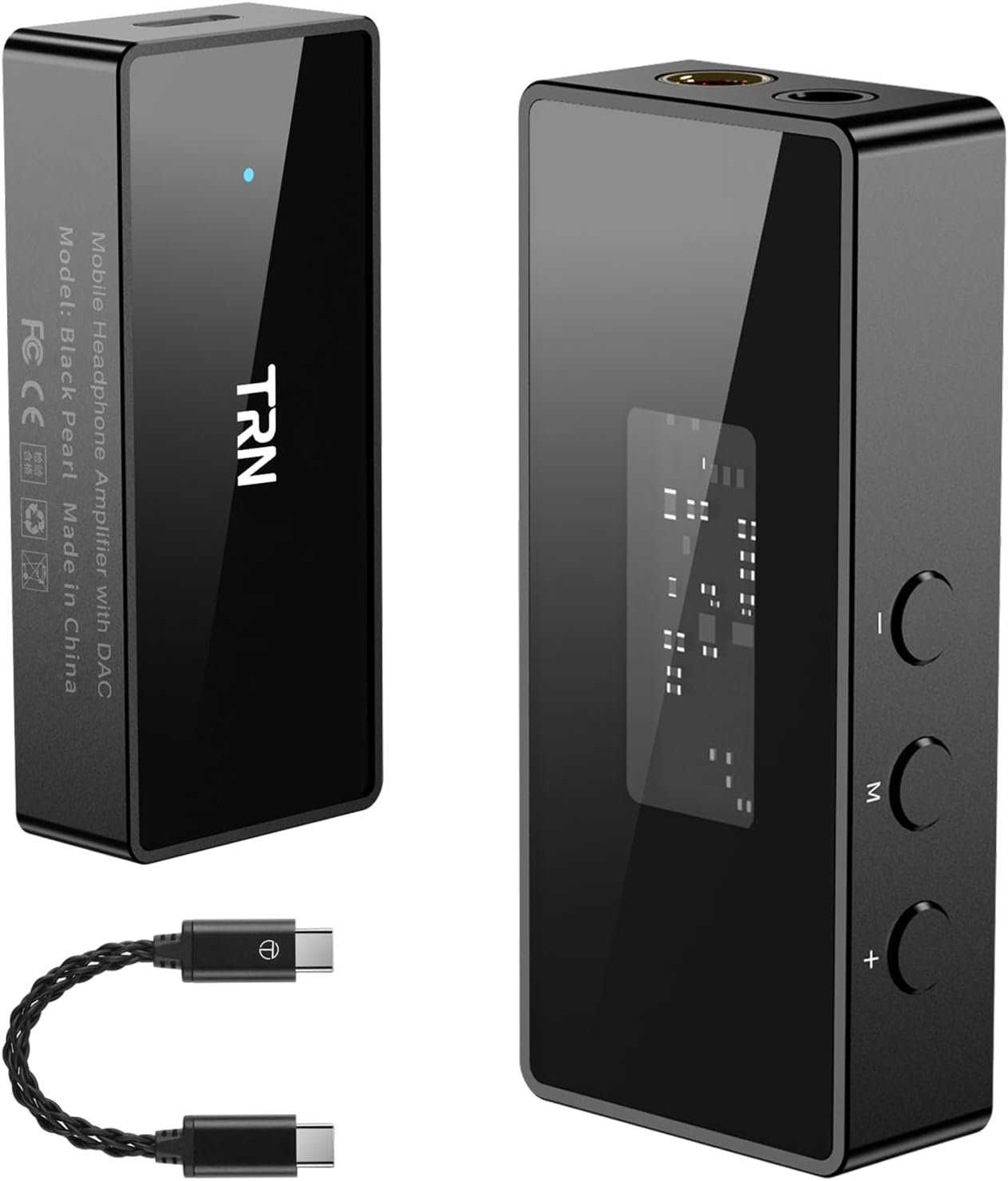
The TRN Black Pearl is a compact USB-C DAC amp that aims to give wired headphones a clear boost without a big footprint. The listing names dual Cirrus Logic CS43131 DAC chips and a CB5100 USB audio bridge, with up to 130dB dynamic range and signal to noise ratio. It supports PCM up to 32-bit/384kHz and DSD256. For shoppers who want a simple dongle with a balanced port, it is a strong value choice. That makes it a sensible starter for anyone new to dongle DACs.
Two outputs are provided. The 3.5mm single-ended port is listed at up to 125mW, and the 4.4mm balanced port at up to 320mW, both at 32 ohms. On Android, the WALK PLAY app offers an 8-band EQ over a wired USB-C link. Built-in buttons handle volume, play and pause, and track changes, while a three-colour indicator shows the signal state. The 3.5mm port also supports calls and recording. The control layout keeps everyday use simple even for first time buyers.
It suits commuters, students and travellers who need something light that works with iPhone and iPad models with USB-C, Android, HarmonyOS, Mac and Windows. At around 25g without the cable, the full-metal body with a tempered-glass panel is easy to carry daily. The included Type-C to Type-C cable means you can start using it right away. Balanced cable owners get a real reason to use the 4.4mm port. It is a tidy answer for anyone who misses a headphone jack on a modern phone.
The EQ app is described for compatible Android devices, so iPhone and computer users should not expect the same tuning features. Download the app only from the source the listing mentions, and read its instructions first. Using only one output at a time is the safe habit. Power is moderate compared with the biggest amps here, so pair it with headphones that are reasonably easy to drive. Keep the cable straight when storing the unit so the connector does not wear.
Light 25g metal body
Both 3.5mm and 4.4mm outputs
Buttons for playback control
Supports calls and recording
EQ app limited to Android
Less power than larger amps
How to Choose the Best Portable Dacs
What a portable DAC actually does
A DAC, short for digital to analog converter, turns the ones and zeros stored in a music file into the electrical signal your headphones can play. Every phone, laptop and tablet already has one built in, but the quality varies a lot. Many modern phones have dropped the headphone jack entirely, which leaves a small adapter doing the job. It is a good idea to compare a few devices on features you will really use.
A portable DAC amp replaces that built-in chip with a dedicated one and adds an amplifier stage, so the sound has more control and headroom. The change is not magic, and results depend on your headphones and your ears. Expect cleaner output and more flexible volume rather than a dramatic transformation, especially with already good earphones. The same logic applies when you pick a first device.
Dongle, Bluetooth receiver or portable amp
Portable DACs fall into three loose groups. Dongles plug straight into a USB-C port and draw power from the source, which keeps them tiny. Bluetooth models add a battery and a wireless chip so they can work with a phone over the air. Larger portable amps include a battery, screen and several inputs, and they act more like a pocket desktop system. Many shoppers start with a dongle and later move to a bigger unit.
Pick based on how you listen. A dongle is great for quick commutes and travel. A Bluetooth model suits people who want wired headphones to behave wirelessly. A larger amp is the better choice for headphones that need real power. The list above spans all three, so you can match the form to your daily routine. Check how you listen most often before you decide.
Understanding output power and impedance
Output power is usually listed in milliwatts at a given impedance, often 32 ohms. Impedance measures how hard a headphone resists the signal. Low impedance earphones need little power, while high impedance full-size headphones usually need more voltage and current. If the amp is too weak, you may hear thin sound or find the volume at its maximum too quiet. Check the listing for the exact power figure at the impedance that matches your gear.
More power is not always better. Very powerful amps can overdrive sensitive earphones if the volume control is too coarse, which is why fine volume steps matter. Look at the power figure, but also check the stated impedance range and gain options. When in doubt, choose a unit that lists power for your type of headphones. A quick look at your headphones’ stated impedance saves guesswork.
Balanced 4.4mm versus single-ended 3.5mm
Single-ended 3.5mm is the standard headphone plug found on most gear. A 4.4mm balanced connection uses separate wires for each side of the signal, which can provide higher power and lower crosstalk in a good design. Many portable DAC amps now offer both, so you can start with ordinary cables and upgrade later. Most players handle either approach well once the right cable is attached.
To use the balanced port, your headphones need a matching 4.4mm cable, or an adapter. Some amps list a higher output on the balanced side, so it can help with demanding models. Do not connect both outputs at once unless the listing says it is allowed. Using one at a time is the simple and safe rule. It is worth checking the plug standard before ordering any cables.
Chips, resolution and what the numbers mean
Listings mention chips from several makers, along with PCM sample rates such as 384kHz and DSD formats such as DSD256. These figures describe what the device can decode, not how good it will sound. A well-designed device with a modest chip can beat a poorly designed one with a flagship name, because the power supply and output stage matter just as much. It also helps to remember that your headphones set a ceiling on what you will hear.
High resolution files only help if your music source supplies them. Streaming at standard quality or listening to compressed files will not show off every feature. Treat the chip name as a rough indicator of intent and focus on features you will use, such as balanced outputs, EQ tools, volume steps and compatible sources. Pay attention to the features rather than the biggest chip name.
Bluetooth codecs and wireless quality
If you choose a model with Bluetooth, codecs matter. SBC is the basic standard, AAC is common on Apple devices, and aptX and LDAC offer higher quality when both ends support them. Lossless options exist in newer standards, but they need a compatible phone and a good signal. Your player will use the best codec both devices share. Bluetooth also adds a short delay, which can matter for gaming or video.
This means a high-end receiver may fall back to a simpler codec if your phone cannot match it. Check your phone settings to see what it supports before you pay for the extras. Wired USB use bypasses the Bluetooth stage, so you can still rely on the DAC chips even if wireless features are not fully used. Many models let you choose wired USB whenever timing matters.
Equalizer and tuning tools
Several picks here include parametric equalizers, which let you adjust specific frequency bands, gain and bandwidth. These tools can tame a harsh treble peak, add weight to the bass or match the sound to a favourite pair of headphones. Some run through an app, while others can be set up in a web browser and saved to the device. Take notes on each change so that you can return to a setting you liked.
A device with onboard memory keeps your settings no matter which source you connect. An app-only system may need the phone to be present for changes. Small adjustments usually sound better than big ones, so start with gentle cuts and boosts. Keep a copy of the original sound so you can compare and avoid overcorrecting. You may find a gentle curve is all you need.
Compatibility with phones, laptops and consoles
Most USB-C dongles work with Android phones, iPads with USB-C, recent iPhone models with USB-C and many laptops. Some units also work with game consoles through a basic USB audio mode, which is useful for handheld play. Always read the compatibility notes, because a few features, such as app EQ, are limited to certain systems. Console modes are usually simpler than computer modes, with fewer settings.
Before buying, check which port your source has and whether it can supply enough power. Some phones limit output current, which can affect louder performance. A short cable helps keep everything tidy in a pocket. If you plan to use calls or recording, look for a listing that says the device supports a microphone through the headphone jack. Look for the exact operating systems mentioned in each listing.
Battery life, heat and power modes
Dongles draw power from the phone or laptop, so they shorten the battery life of that device. Models with their own batteries avoid that, but they need charging as well. Some devices offer power modes, such as an eco setting for longer use and a boost setting for harder to drive headphones. A short charging routine before travel avoids surprises later in the day.
Warmth is normal when an amp works hard, especially in a metal housing that doubles as a heat sink. Avoid leaving a device in direct sunlight or in a hot car. For longer sessions, consider a power adapter or desktop mode if the listing offers one. Pay attention to charging ports so you do not mix up input and output. Reading the manual helps you spot which button controls each power mode.
Build quality, portability and everyday carry
Metal bodies such as aluminum alloy feel solid and help shed heat. Smaller units are easy to pocket, but they may offer fewer controls. Larger units add screens, buttons and extra ports, which make them easier to adjust but harder to carry. Think about how often you will take the device outside the house. Many people choose the slimmest option that still offers the ports they need. Weigh these trade offs against how you actually travel.
Cables matter too. A short, flexible cable keeps a phone and dongle neat, while a stiff one can strain the port. Protective cases or magnetic mounts help keep a stack together. If you commute on crowded transport, choose a design that does not catch on clothing or bags. A stable fit between phone and device also reduces cable strain. Wiping the metal body with a soft dry cloth keeps the finish looking neat.
Safe listening and getting the best result
Powerful amps can make headphones very loud, so begin with the volume at its lowest and raise it slowly. Listening at high volume for long periods can be uncomfortable and unsafe, so take breaks and keep levels moderate. If anything sounds distorted or painful, turn it down straight away. Taking short breaks lets you notice fatigue before it becomes a problem.
For the best result, use well-encoded music, a good cable and a snug fit for your earphones or headphones. A DAC amp cannot fix poor recordings or an ill-fitting seal. Make one change at a time, such as a new filter or a different output, so you can tell what helped and what did not. This habit matters more with powerful amps than with small dongles.
How to choose among these picks
Start with your headphones. Sensitive IEMs need clean, low-noise output and fine volume control, which makes the dongles and mid-power models ideal. Demanding full-size headphones call for higher power, so look at the larger amps. Next, decide whether you want Bluetooth, a screen, or a built-in EQ. Do not be afraid to start with the model that fits your current gear rather than your future wish list.
Then think about how you carry gear. A clip-on or magnetic option suits phone listening, while a larger battery powered unit fits a desk or bag. Compare the extras you will really use, not the biggest numbers. Finally, check live listings for current details, because versions, colours and bundles can change between sellers. Read the live listing for the latest details before you order.
Frequently Asked Questions
What is a portable DAC?
It is a small device that converts digital audio from a phone or computer into an analog signal for your headphones, usually with an amplifier built in. It replaces the weaker chip in many devices and can improve volume control, clarity and compatibility with demanding headphones.
Do I need a portable DAC for my phone?
Not always. Many phones sound fine with ordinary earphones. A portable DAC helps most when your phone has no headphone jack, when you use demanding headphones, or when you want extra tools such as EQ and balanced output.
Will a DAC amp make my headphones sound better?
It can help by offering more power, lower noise and better control, but the difference depends on your headphones and files. Do not expect a huge change with entry level earphones. Matching power and impedance gives the most noticeable benefit.
What is the difference between 3.5mm and 4.4mm outputs?
The 3.5mm port is the common single-ended plug. The 4.4mm port is a balanced connection that needs a matching cable and often offers more power. Many models provide both, so you can use ordinary gear now and upgrade later.
How much power do I need?
Sensitive IEMs need very little, while high impedance full-size headphones need much more. Check the maker’s impedance range and the power listed at 32 ohms. If you are unsure, pick a model with a fine volume control and some extra headroom.
Are Bluetooth DAC amps as good as wired ones?
Wired USB gives a direct digital connection, while Bluetooth depends on the codec shared by both devices. Modern codecs such as LDAC and aptX can sound very good. Choose a model that offers both so you can pick whichever suits the moment.
Can I use a USB-C DAC with an iPhone?
Many USB-C dongles work with iPhone models that have a USB-C port, and some listings say so directly. Older Lightning iPhones need a different adapter. Read the compatibility notes, because app features may be limited to certain systems.
Do portable DACs drain my phone battery?
Dongles that draw power from the source can shorten the phone’s battery life, especially with power hungry headphones. Models with their own battery avoid that but need charging. Some units also offer eco or desktop modes to manage power use.
Is a tube DAC amp worth trying?
A hybrid tube design can add a warm, smooth tone that some listeners enjoy, but it is a matter of taste. It can also be more delicate than solid-state designs. If you prefer a neutral tone, a standard DAC amp may suit you better.
How loud is safe when using a powerful amp?
Always start at the lowest volume and increase slowly. Listening at high volumes for long periods is not advised, so keep levels moderate and take breaks. If sound becomes uncomfortable or distorted, lower the volume immediately.
The Bottom Line
Choosing the best portable dacs comes down to your headphones, your source and your routine. The FiiO QX13 is our top pick for anyone who wants plenty of power, a flagship DAC and a rich set of controls in a portable body.
If you want something smaller, the KA15, BTR13 and Black Pearl keep things light, while the iDSD GR 2 and BTR17 add wireless and extra inputs. Use the links to check live listings, and keep your listening volume moderate.
Updated for the 2027 buying season. Amazon listings and availability change often, so check the product page for current details.
Write Your Review
No reviews yet. Be the first to share your experience!