

As an Amazon Associate we earn from qualifying purchases. If you buy through links on this page we may receive a commission at no extra cost to you. Product details come from Amazon listings and can change.
If you are shopping for the best headphone DACs, you are probably chasing cleaner sound than a laptop jack or phone dongle can give. A DAC, short for digital to analog converter, turns the ones and zeros from your computer, console or phone into the signal your headphones play. A good one lowers noise, adds output power and gives you proper volume control.
This guide covers ten models, from compact desktop boxes with balanced outputs to tiny USB-C dongles that fit in a pocket. It is written for gamers, students, home office workers, commuters and music fans who want a clear step up from built-in audio. Each pick explains the inputs, outputs and power the listing describes, plus who should buy it and what to watch for.
Prices change often and stock moves between colours and bundles, so we link to live listings instead of printing numbers. Check the current offer, confirm the connectors match your gear, and keep listening volume at a comfortable level, because extra amplifier power makes it easy to play music louder than you intend.
The TOPPING DX1 II is our top pick for its balanced output, 10-band parametric EQ and console friendly modes. The Fosi Audio ZH3 is the best fully balanced desktop choice, while the Fosi Audio DS2 is the pick for phones and laptops on the move.
Key Takeaways
Best Headphone Dacs at a Glance
| Product | Our score | |
|---|---|---|
| 8.8 / 10 | Check Price → | |

Fosi Audio ZH3 DAC Headphone AmplifierBest Fully Balanced Desktop
|
9.0 / 10 | Check Price → |

FiiO K11 Desktop 1400mW Power Balanced Headphone DAC &Best for High Power
|
9.6 / 10 | Check Price → |

Fosi Audio K7 DAC Headphone AmpBest for Wireless and Wired Inputs
|
9.4 / 10 | Check Price → |

FiiO K13 R2R Desktop DAC & Headphone AmpBest for R2R Sound
|
9.2 / 10 | Check Price → |

Fosi Audio C3 Gaming DAC Amp for PCBest for Gaming Audio
|
9.2 / 10 | Check Price → |

Fosi Audio K5 Pro Gaming DAC Headphone AmpBest Value Gaming Combo
|
8.4 / 10 | Check Price → |

Fosi Audio DS2 USB C to AUX Headphone AmpBest Portable Dongle
|
8.6 / 10 | Check Price → |
TRN Black Pearl USB-C DAC AmpBest Pocket DAC for IEMs
|
9.2 / 10 | Check Price → |

AIYIMA DAC-A2 Headphone Amplifier & Desktop DAC for PCBest Entry Desktop
|
8.4 / 10 | Check Price → |
How We Chose the Best Headphone Dacs
This is a research based guide, not a lab comparison. We read each product listing closely, noting the DAC chips, supported sample rates, output connectors, quoted power, input types and extra features such as EQ, displays and gain switches. We then matched those details to real use cases, such as gaming on a console, listening at a desk, or plugging into a phone on a train.
Where a listing did not state a figure, we speak in general terms about how DACs and amplifiers work rather than guess. Every pick has an editorial score out of 10 shown on the page, based on how well its listed features fit its intended job, how flexible its connections are, and how clearly its limits are stated. Duplicate listings of the same model were merged into one entry.
In-Depth Reviews
1TOPPING DX1 II Gaming DAC Headphone Amplifier with 10-Band

The TOPPING DX1 II takes the top spot because it combines a modern ESS ES9039Q2M DAC with an XMOS XU316 USB processor in a compact desktop case, then adds features that suit both gamers and music fans. The listing describes PCM up to 384kHz and DSD256 playback, a four-channel fully balanced amp stage and a 4.4mm balanced output. It is a rare box that feels at home next to a gaming PC and a hi-fi rack alike. That blend of gaming tools and hi-fi hardware is the reason it leads the group.
Its standout feature is a 10-band parametric EQ with control over frequency, gain and bandwidth, plus independent left and right tuning through TOPPING Tune software. You can save profiles for footsteps, positional cues, music or speakers. The amp is quoted at up to 1000mW per channel into 32Ω from the balanced output. Optical input and output let the unit process sound from TVs, streamers and consoles, while RCA and 4.4mm line outputs feed active speakers. Each filter band can be adjusted on its own, so a single harsh peak can be tamed without dulling everything else.
This model suits people who want one device to cover several jobs. Gamers get UAC 1.0 and UAC 2.0 switching for plug-and-play use with PC, Mac, tablets, Nintendo Switch and PlayStation 5. Streamers and meeting regulars can use the 3.5mm TRRS jack for headsets with a microphone, which the listing says handles input up to 24-bit/192kHz. Desk listeners with in-ear monitors or high-impedance headphones will enjoy the balanced output. The same box can also serve a compact stereo system, which gives it value beyond the desk.
A few practical points are worth knowing. The tuning software is part of the appeal, so plan to spend some time building profiles rather than leaving everything flat. Balanced output needs a headphone cable with a 4.4mm plug, which may mean buying a new cable or adapter. As with any powerful amp, start with the volume low, raise it slowly and keep long sessions at a moderate level to protect your ears. Treat it as a long term desk upgrade and spend a little time on setup.
Balanced 4.4mm and 3.5mm outputs
10-band PEQ with left and right control
Works with PC, Mac, Switch and PS5
Optical input and output for DSP use
Needs software time to get the best from EQ
Balanced output needs a matching cable
2Fosi Audio ZH3 DAC Headphone Amplifier
The Fosi Audio ZH3 is a desktop DAC, headphone amp and preamp rolled into one, and the listing leans hard on its fully balanced design. It pairs an AKM4493SEQ DAC with an XMOS XU316 processor and four OPA1612 op-amps. The quoted decoding ceiling is PCM 768kHz at 32 bit and DSD512, which is among the highest numbers in this group. It earns its place as the pick for people who want a serious desk centrepiece. The spec sheet reads like a hi-fi component at a desktop size.
Inside, a self-developed dual-power balanced circuit uses low-noise regulators to keep the noise floor down, and the listing gives a figure as low as 1.9 microvolts. Outputs are generous: a 6.35mm single-ended jack rated at 640mW per channel into 32Ω and a 4.4mm balanced jack rated at 2570mW per channel into 32Ω. A three-level gain switch covers headphones from 16Ω to 300Ω, so sensitive in-ears and hungry over-ears are both in scope. Such headroom suits planar magnetic designs, which tend to ask for plenty of current.
Because it also acts as a preamp, the ZH3 suits listeners who run active speakers as well as headphones. Inputs include coaxial, optical, USB and RCA, and outputs add RCA and XLR for the speaker side. UAC mode switching is included for game console compatibility, so it can serve as a living room or desk hub. Tone shapers will like the bass and treble adjustments, six filter types, a Bypass mode and two swappable op-amps. Fans of a single clean hub for headphones and speakers will find it very convenient.
There are notes worth reading before you buy. The listing warns that RCA and XLR output levels differ significantly, so match the level to your speakers or power amp and keep the volume down when switching. It also says EQ only applies to the headphone output, not the preamp output. Finally, high gain and balanced power can be loud, so begin quietly and step up with care. Space on the desk is also worth planning, since the unit has a screen and many connectors.
Fully balanced circuit with low noise
Very high quoted power from 4.4mm
Works as DAC, amp and preamp
Swappable op-amps and six filters
RCA and XLR levels differ a lot
EQ does not affect the preamp output
3FiiO K11 Desktop 1400mW Power Balanced Headphone DAC &
The FiiO K11 is a desktop DAC and headphone amplifier that focuses on clean power and a readable screen. The listing quotes up to 1400mW in balanced mode and describes multiple low-noise regulators fed by an external 12V supply. This listing is the Titanium finish, and the same unit is also sold in silver, so we count it once. It is a straightforward, well equipped choice for a home or office desk. Its focus is on steady, reliable power rather than gimmicks.
Connections cover most desktop needs. Inputs include USB, coaxial and optical, with the digital inputs supporting up to 192kHz, while the USB path handles 384kHz at 24 bit and DSD256. Outputs include 4.4mm balanced, 6.35mm single-ended, RCA line-out and coaxial out. The RCA line-out level is adjustable up to a maximum of 2Vrms, so the K11 can drive active speakers or a separate power amp as well as headphones. Having every setting visible at a glance also makes switching between headphones less error prone.
A high-contrast VA display shows items such as sampling rate, volume, gain and output mode, which makes everyday operation more intuitive than guessing from tiny lights. The listing says the amp handles low and high impedance headphones, with 1400mW at 32Ω balanced and 250mW at 300Ω balanced. That makes it a good match for people who own a mix, such as sensitive in-ear monitors and a pair of demanding open-back headphones. Balanced and single-ended jacks sit side by side, so mixed collections are well covered.
Remember that the K11 is a desk device and needs its external power supply, so it is not for travel. It does not list Bluetooth, so streaming from a phone means a wired link. Balanced output is the most powerful path, which means some owners will want a 4.4mm cable. As always, set the volume low before plugging in new headphones, because the available power can be far more than they need. Cable planning is part of the job, because RCA and balanced leads add to the desk clutter.
Up to 1400mW in balanced mode
Clear VA display shows status
USB, optical and coaxial inputs
RCA line-out adjustable to 2Vrms
Needs external power, desk use only
No wireless input listed
4Fosi Audio K7 DAC Headphone Amp
The Fosi Audio K7 is billed as an all-in-one desktop DAC headphone amp for hi-fi fans, gamers and everyday listeners. Its chain pairs an AK4493S DAC with an XMOS XU208 USB processor and a TPA6120 headphone amp stage. The listing quotes decoding up to PCM 384kHz at 32 bit and DSD256, with output power up to 2100mW. It lands high on this list because it is so flexible. Few units in this guide offer such a wide range of connection options.
Where it stands out is the input list: USB-C, optical, coaxial and Bluetooth with aptX HD and aptX LL support, plus a 3.5mm microphone input. Outputs include a 4.4mm balanced jack, a 3.5mm jack and RCA. Built-in adjustable EQ and a Bypass mode let you tailor sound for games or music. Bluetooth is handy for quick listening from a phone, while the wired inputs are better for critical listening. A mic jack on the front side is a thoughtful extra for chat and calls.
Controls are a real strength. Two knobs, five shortcut buttons and a high-resolution display give quick access to settings and real-time status, and you can switch between headphones and speakers or among four input sources without menu diving. That makes it a good fit for a shared desk where a PC, a TV and a phone all want the same headphones. Gamers will like having a microphone input beside the main outputs. The retro-inspired, angled body also makes the controls easy to reach from a seated position.
A few cautions apply. The metal chassis is solid, so expect a desktop footprint rather than a tiny box. Bluetooth quality depends on your source supporting the same codec, and aptX LL is aimed at lower delay for video and games, so check your phone or transmitter. High output power calls for care with efficient headphones, so begin at a low setting and keep sessions at a comfortable volume. Reading the manual helps, since a unit with this many inputs has several modes to learn.
Bluetooth aptX HD and aptX LL included
4.4mm balanced, 3.5mm and RCA outputs
Display, dual knobs and shortcut buttons
Built-in EQ with Bypass mode
Bluetooth depends on source codec support
Larger than dongle style DACs
5FiiO K13 R2R Desktop DAC & Headphone Amp
The FiiO K13 R2R is for listeners who like the idea of a ladder DAC. Instead of a standard delta-sigma chip, the listing describes a self-developed four-channel fully differential 24 bit R2R design built from 192 precise thin-film resistors. FiiO says it gives an analog-like timbre with strong musicality. It is the most distinctive DAC here and makes the list as the choice for tinkerers and warm sound fans. Listeners who enjoy exploring different DAC designs will find it a good talking point.
Two listening modes add flexibility. NOS mode, short for non-oversampling, keeps the original sample rate for what the listing calls pure, natural sound, while OS mode upsamples to 384kHz for improved measurements. The unit supports PCM 384kHz at 32 bit and DSD256 decoding, and quotes up to 2400mW of power. A dual power supply is part of the design, aimed at steady, clean delivery to demanding headphones. Both modes can be switched in a moment, which makes comparing them easy.
Connections look like a hi-fi component. Outputs include XLR balanced line out, dual RCA, 4.4mm balanced headphone out and 6.35mm single-ended headphone out, so it can sit in front of powered speakers too. It adds LDAC, AAC and SBC over Bluetooth 5.4, which is useful for wireless streaming from compatible phones. A 10-band parametric EQ with app control, web interface, presets and shared profiles suits people who like to correct or colour a headphone response. Such a full set of outputs lets it anchor a bigger audio rack over time.
Think about the details before choosing it. The R2R approach is a matter of taste, and some listeners prefer the sharper, more clinical sound of other chips, so try NOS and OS modes to hear which suits you. The Bluetooth LDAC link needs a source that supports it. Power is high, so use low volume first and leave extra headroom rather than turning the knob far. It rewards patience, and a few evenings of listening will reveal which mode you like.
Self-developed 24 bit R2R DAC
NOS and OS listening modes
XLR, RCA, 4.4mm and 6.35mm outputs
LDAC Bluetooth and 10-band PEQ
R2R tone is a matter of taste
LDAC needs a compatible source
6Fosi Audio C3 Gaming DAC Amp for PC
The Fosi Audio C3 is a USB DAC amp designed with competitive gaming in mind. The listing says it is a new model based on the K7 and adds StepSense, a feature meant to bring out enemy movement while balancing gunfire and explosions. It uses a flagship CS43131 DAC supporting 32-bit/384kHz PCM and DSD256, and quotes 320mW per channel for headphones from 16Ω to 300Ω. Its design is very clearly aimed at shooters and similar fast paced titles.
Positional audio is a core idea. Native 7.1 surround and HRTF processing aim to create a wide, 360 degree image through any stereo headset, which can help with placing footsteps and vehicles. Intelligent mic processing is included to reduce keyboard and background noise on voice chat. Sound can be tuned from a browser using presets and custom EQ profiles for gaming, music and streaming, so no heavy software install is described. The browser based control approach keeps the desk free of extra programs.
A single USB-C connection keeps the desk tidy, and the CNC aluminium body is compact. UAC mode switching is the key to compatibility. UAC 1.0 runs at 16 bit and 48kHz for plug-and-play use with consoles, and supports the game enhancements, while UAC 2.0 at 32 bit and 384kHz unlocks full hi-fi decoding for movies and music. That makes it a good choice for someone who plays on a console and a PC. Because the case is small, it fits easily beside a keyboard or under a monitor.
Keep expectations realistic. Surround processing is a virtual effect on stereo headphones, and some players will like it while others prefer a plain stereo image, so try the settings on and off. The high-resolution mode is for PC style use, while console mode runs at a lower rate. Competitive sound can be loud, so keep the level moderate and take breaks during long matches. Remember that the enhancement features are about advantage in play, not about purist music playback.
StepSense footstep enhancement
7.1 surround with HRTF
Mic noise reduction for voice chat
UAC 1.0 and 2.0 switching
Virtual surround is not for everyone
Console mode uses a lower sample rate
7Fosi Audio K5 Pro Gaming DAC Headphone Amp
The Fosi Audio K5 Pro is the upgraded version of the Q4, and the main addition named in the listing is a microphone function. It is a headphone DAC and amp combo marketed for home gaming setups. It sits in the value section of this guide because it brings tone controls, several inputs and a generous power figure for its size, all in a small desk footprint, without the extra cost of balanced designs. It remains a sensible first step for anyone moving beyond built-in audio.
The listing says the DAC converts USB Type-C, optical and coaxial signals to 3.5mm and RCA outputs with low distortion and wide dynamic range. The amp stage uses a Texas Instruments NE5532 op-amp, and the circuit is described as optimised for a low noise floor. Quoted specs include THD of 0.003% or less and an SNR of 110dB or better, with USB at up to 24 bit and 96kHz and optical and coaxial up to 24 bit and 192kHz. Optical and coaxial inputs make it useful for a TV or console as well as a computer.
Power is quoted at 1000mW into 16Ω, 500mW into 32Ω, 300mW into 64Ω, 150mW into 128Ω and 80mW into 300Ω. That curve shows why it suits easy to drive headphones and gaming headsets better than very demanding designs. Master volume, bass and treble controls and an input mode switch keep operation simple. The USB-C port doubles as an input for phones, with a note that the source must be connected to the USB-C side. Simple knobs mean there is no software to learn before you start listening.
Check the fine print before buying. The listing includes a note about which port to use with a phone, and you should follow it to avoid a silent connection. Power drops as impedance rises, so a 300Ω headphone will not get the same drive as a 32Ω one. The bundle includes an optical cable, a headphone splitter, a USB cable and a manual, which covers most first setups. Treat the output table as a guide to which headphones will pair best.
Bass, treble and master volume controls
Optical and coaxial up to 24 bit/192kHz
Low distortion and noise figures listed
Bundle includes optical cable and splitter
USB path tops out at 24 bit/96kHz
Power falls off with high impedance headphones
8Fosi Audio DS2 USB C to AUX Headphone Amp
The Fosi Audio DS2 is a USB-C dongle that turns a phone, tablet or computer into a more capable source. It supports PCM up to 32 bit and 384kHz plus DSD256, and the listing quotes up to 170mW per channel at 32Ω. Two Cirrus Logic CS43131 DAC chips sit inside. It is our top portable pick because it keeps the feature list rich while staying pocket sized. It is easy to see why portable listeners find this style so appealing.
The listing claims a very low 1 microvolt noise floor, 0.0001% THD, 130dB SNR and 109dB SINAD. It offers both 3.5mm single-ended and 4.4mm balanced outputs, so you can use common wired headphones or balanced cables. The design is meant to deliver good results without draining the source device battery. A 60-step volume control with volume memory gives smoother adjustment than many phone sliders. Balanced output in a dongle is a notable feature for pairing with premium in-ear monitors.
Compatibility is wide. The listing names recent USB-C phones, tablets and Android devices, and says it can also act as an external sound card for a laptop or Mac. That makes it handy for students and commuters who switch between a phone on the bus and a laptop in class. Setup is plug and play, with no complicated menus described, so it is easy to recommend to first time DAC buyers. Stepped volume also makes it simpler to return to the same comfortable level each time.
There are limits to bear in mind. A dongle draws power from the host device, so output is far lower than on a desktop unit, and demanding headphones may need more than it can supply. The listing mentions a CNC metal body, which is sturdy but can mark if kept loose with keys. Use the volume steps gently, because low impedance in-ears can get loud quickly on a clean amp. Treat it as a mobile companion rather than a desk replacement.
Dual CS43131 DAC chips
3.5mm single-ended and 4.4mm balanced
60-step volume with memory
CNC metal body
Lower power than desktop units
Some host devices may need a cable
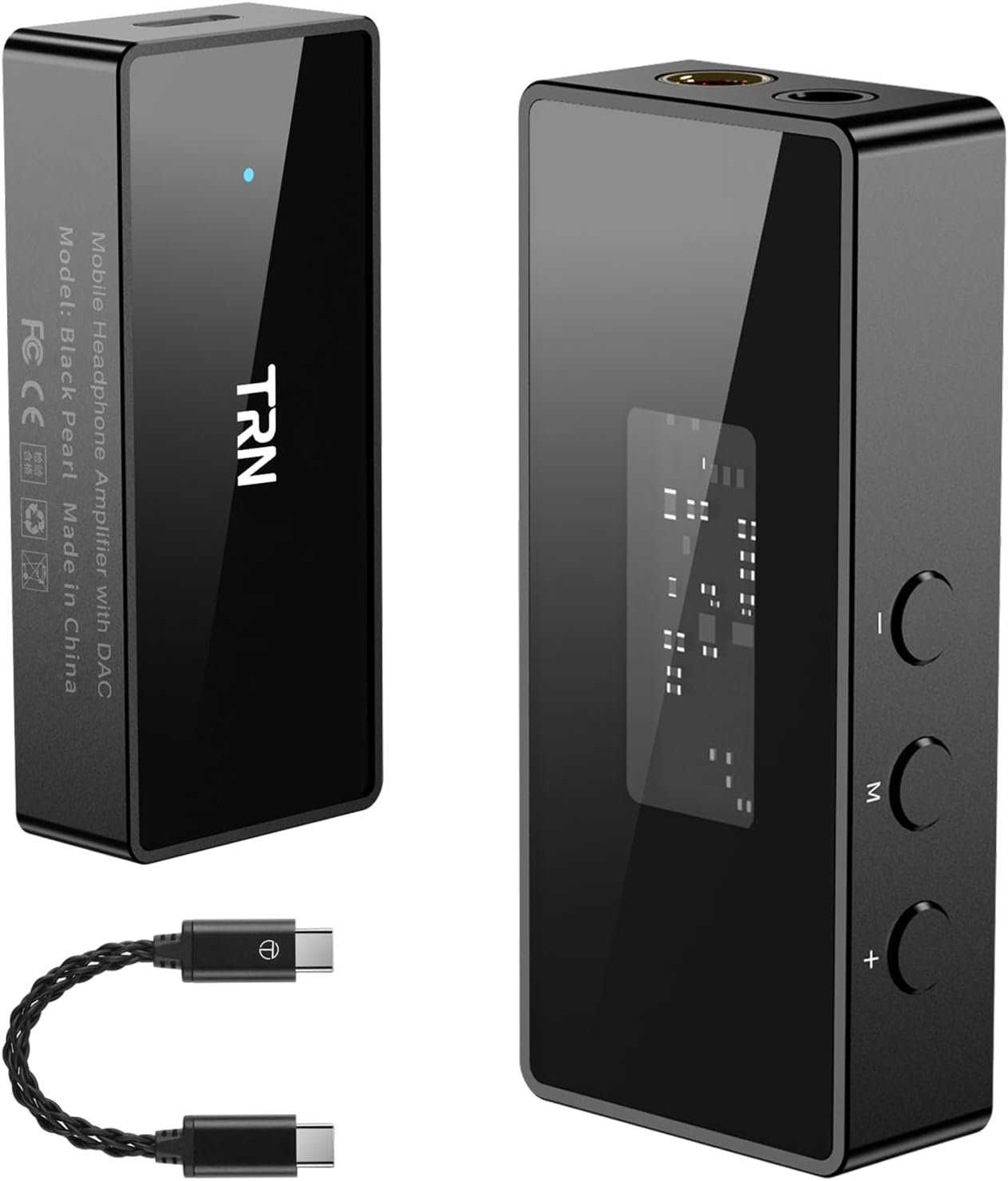
9TRN Black Pearl USB-C DAC Amp
The TRN Black Pearl is a USB-C DAC amp aimed at people who use wired in-ear monitors and want a small upgrade for their phone or laptop. Built with dual Cirrus Logic CS43131 DAC chips and a CB5100 USB audio bridge, it supports PCM up to 32 bit and 384kHz and DSD256. The listing quotes up to 130dB dynamic range and SNR, with THD+N as low as minus 110dB. Its approach is to bring a proper two output design into a body smaller than a matchbox.
Two outputs set it apart from basic dongles. A 3.5mm single-ended jack delivers up to 125mW at 32Ω, and a 4.4mm balanced jack delivers up to 320mW at 32Ω. The listing says you can use one output at a time. An 8-band EQ is available on compatible Android devices through the WALK PLAY app over a wired USB-C link. On-device buttons handle volume, play and pause, and track changes, with a three-color indicator. Choosing the right port for each pair of headphones is the main thing to remember.
It is built for carrying around. The full-metal body with a tempered-glass panel weighs about 25g without the cable, and the box includes a Type-C to Type-C cable. The 3.5mm port is said to support calls, recording and standard listening, which suits commuters who take calls on the move. Mac and Windows computers are also named, so it can sit beside a laptop at a coffee shop. It is a sensible fit for people who record voice or take calls with the same headphones.
Read the compatibility notes. The EQ app is described for compatible Android devices, so iPhone users should not expect that feature. The balanced output needs a 4.4mm cable, which many in-ear sets do not include. A glass panel looks good but deserves a pouch in a bag. Because in-ears are sensitive, start with the volume near the bottom and raise it slowly. It is a travel friendly choice, provided you handle it with a little care.
Dual CS43131 with CB5100 bridge
3.5mm and 4.4mm outputs
On-device volume and track buttons
Light at about 25g
EQ app limited to compatible Android
Balanced output needs a 4.4mm cable
10AIYIMA DAC-A2 Headphone Amplifier & Desktop DAC for PC
The AIYIMA DAC-A2 is the simplest desktop option here, and that is its appeal. The listing describes a plug-and-play box that needs no drivers or software, which connects to a PC, Mac, television or gaming console. It converts optical, coaxial and USB digital signals into RCA or 3.5mm analog outputs. For someone buying a first external DAC, this is a gentle step into the category. Sometimes the simplest design is the most welcome, and this one keeps things clear.
Sound shaping is kept physical. Front-panel rotary knobs control bass, treble and volume, so you can adjust music, movies or podcasts without opening an app. The listing quotes 160mW RMS at 32Ω, enough to drive headphones from 16Ω to 200Ω, and says it supports bit-perfect audio up to 24 bit and 192kHz over optical or coaxial. A built-in output protection circuit is meant to protect connected gear. Those physical controls are quick to reach and easy to understand for new owners.
The full-metal aluminium case is described as a shield against electromagnetic interference, which helps keep the signal clean on a crowded desk. It also sends analog sound to powered speakers through RCA, so it can serve a small stereo as well as a headset. That makes it practical for students and home office users who want better sound from a TV, monitor or speakers with minimal fuss. It also suits a shared family computer, where plug-and-play matters more than settings.
Keep the scope in view. It lacks balanced outputs, a display and advanced EQ, so people who want fine tuning will outgrow it faster than owners of the more feature rich models. The listing also notes that you should use a compatible audio cable, such as an A-to-C cable with a charger, so check your connection before you plug in. Start with the volume low and increase gradually. It works best as a modest upgrade, so keep expectations in line with its size.
No drivers or software needed
Bass, treble and volume knobs
Optical and coaxial up to 24 bit/192kHz
Metal case with output protection
No balanced output or display
Limited tuning compared with feature rich units
How to Choose the Best Headphone Dacs
What a headphone DAC actually does
Every digital audio source, from a laptop to a game console, stores sound as numbers. A DAC converts those numbers into a smooth electrical wave that an amplifier can push into your headphones. Every computer and phone has one built in, but it sits near noisy parts and is often designed to be cheap to make and small, not to sound excellent. This is the basic idea behind every product reviewed here.
An external DAC moves that job into a dedicated box with cleaner power and better parts. The benefit shows up as lower background hiss, tighter control over bass and a calmer top end. Many models, including all ten here, also contain a headphone amplifier, which is why you will see the combined term DAC amp in listings. In practice the difference is easiest to hear on a quiet desk with good headphones.
DAC versus amp: why most listings sell both
A DAC and an amplifier do different jobs. The DAC creates the audio signal, and the amp raises its strength so that it can move the drivers inside your headphones. In a combined unit the two share a case and a power supply, which keeps cables short and setup simple for desk users. That split of jobs is why the two parts are so often sold together.
Some products in this space sell only an amp, and they need a separate source. We kept this guide to units that include DAC chips. That way you can plug a computer straight in over USB, or send optical and coaxial from a TV and console, with no other hardware needed. Reading each listing with that in mind makes the specifications far easier to follow.
Reading sample rate and bit depth numbers
You will see figures such as 24 bit and 192kHz, or 32 bit and 384kHz, on every listing. Bit depth describes how finely each sample is measured, and sample rate describes how many samples are taken per second. Higher numbers allow the DAC to handle more detailed files, but they do not guarantee that your music will sound better. These numbers help you judge a spec sheet, but they are only part of the picture.
Most streaming music and standard downloads fit comfortably within 24 bit and 96kHz. Very high rates and DSD formats matter mainly if you own native high-resolution files. Treat the biggest numbers as headroom, and put your attention on noise, power, connectors and ease of use, which affect daily listening more. In short, treat very high figures as extra headroom and not as a promise of better sound.
Matching power to headphone impedance
Impedance, measured in ohms, tells you how hard a headphone resists the current from an amp. Low impedance in-ear monitors and gaming headsets are easy to drive. High impedance studio models and planar magnetic headphones usually need more voltage and current to reach a good volume with proper control. Matching the two properly is what gives good volume without strain or distortion.
Listings quote power at set impedances, such as 32Ω or 300Ω, and the figure usually falls as impedance rises on simple amps. Check the headphone spec sheet, then pick a DAC amp whose rated output at that impedance is comfortably above what you need. Extra power is only headroom, so never judge loudness by the maximum number. Plenty of headroom is useful, but your ears should always set the limit on loudness.
Balanced 4.4mm outputs explained
A balanced headphone output uses separate wires for each side of the signal, with a plug such as the 4.4mm connector. In a well built amp this design can supply more power and lower crosstalk than a single-ended jack. It does not make every pair of headphones sound better by itself, but it often unlocks the highest quoted output on a unit. Many listeners find this connector to be a simple, tidy way of using the extra power.
To use it you need a headphone with a balanced cable or an adapter that fits. Several picks here, including the TOPPING DX1 II, Fosi Audio ZH3 and FiiO K11, put their strongest output on the balanced port. If you only own ordinary 3.5mm or 6.35mm headphones, the single-ended jack on the same unit will still work well. Plan the cable purchase before the DAC arrives, and the first listening session will go smoothly.
USB, optical and coaxial inputs
USB is the easiest way to connect a computer, since it carries both data and, on many desktops, power. Optical and coaxial inputs are digital links used by televisions, consoles, CD players and network streamers. Each has strengths, and the best choice is simply the one your source device supports. Pick the connection that suits each device and avoid adapters where you can.
A DAC with several inputs works like a switchboard for your desk. You might leave a PC on USB, a console on optical and a streamer on coaxial, then pick the active source with a button or knob. Models such as the Fosi Audio K7 and FiiO K13 R2R go further and add Bluetooth for wireless streaming from a phone. This flexibility is a quiet strength of desktop units compared with portable ones.
Gaming features: UAC modes, EQ and positional audio
Game consoles and some tablets expect a simple class compliant USB audio device, which is why you will see UAC 1.0 and UAC 2.0 switches. UAC 1.0 is the plug-and-play mode with a lower sample rate. UAC 2.0 supports the full high-resolution range, mainly for PCs and Macs where drivers handle it without trouble. Compatibility with the console or PC you actually own is the first thing to confirm.
Gaming oriented units add tools such as parametric EQ, footstep enhancement, surround processing and microphone noise reduction. The TOPPING DX1 II, Fosi Audio C3 and Fosi Audio K7 lean in this direction. These features change the sound on purpose, so try them with your favourite games and keep a flat profile ready for music. Experiment with the settings, and keep a note of the profile you like best for each game.
Portable dongles versus desktop DACs
A dongle plugs into a phone or laptop and takes its power from the host. It is small, light and easy to carry, but power and connector choices are limited. The Fosi Audio DS2 and TRN Black Pearl show how much you can still get, with balanced outputs and good chips in a pocket sized body. Many owners choose one of each type and enjoy the benefits of both setups.
A desktop DAC amp uses its own power supply, which allows higher output, more inputs, knobs and displays. It is the better choice if the unit will stay at one desk or in a living room rack. If you split your day between a desk and a commute, you may end up using both types. Which type is right depends mostly on where you listen most often.
Tone controls, filters and parametric EQ
Simple bass and treble knobs, like those on the AIYIMA DAC-A2 and Fosi Audio K5 Pro, let you nudge the sound without software. They are quick to use and good for adjusting to different rooms, movies or songs. Their downside is that they affect broad regions of the spectrum rather than one narrow problem. Starting with simple tone controls is a friendly way to learn what you like.
Parametric EQ lets you set the exact frequency, gain and width of each band, which is powerful for correcting a headphone response or reducing a harsh peak. Units such as the TOPPING DX1 II and FiiO K13 R2R offer ten bands. Digital filter choices, found on the Fosi Audio ZH3, change how the DAC treats timing and ringing and are a matter of taste. Try small changes first, since a couple of decibels is usually plenty.
Setup tips for a quiet, clean signal
Start with the basics. Use the shortest good quality cable you can, plug the DAC into a USB port on the computer itself rather than a crowded hub, and keep it away from phone chargers and routers. Choose the DAC as the system output in your operating system, and set the system volume to a high fixed level so that the DAC volume controls the loudness. A tidy setup also makes it easier to spot problems when something sounds wrong.
Before connecting headphones, turn the DAC volume to a low point, and select the gain setting that suits your headphones. Raise the level slowly until it sounds comfortable. If you hear hiss with sensitive in-ears, drop to low gain. Always unplug headphones or turn down the volume before switching inputs or changing modes. Following these steps takes only a few minutes and pays off with a smoother listening experience.
Safe listening with powerful amplifiers
A strong amplifier can reach volumes that are far higher than a phone jack, and it can do so with very little distortion, which hides how loud it has become. Long sessions at high levels can be uncomfortable and may harm hearing over time. Set a comfortable level, and treat the maximum output figure as headroom rather than a target. These precautions cost nothing and are worth following for every listener.
Good habits help. Take short breaks during long gaming or editing sessions, keep the volume lower late at night, and be careful when swapping between efficient in-ears and demanding over-ears on the same unit. If you share the device with a family member or child, supervise it and keep levels low. Comfortable levels are the best choice, no matter how clean the sound feels.
Who should buy which DAC
For a mix of gaming and music at a desk, the TOPPING DX1 II and Fosi Audio K7 are strong starting points. For serious hi-fi headphones or active speakers, look at the Fosi Audio ZH3, FiiO K11 or FiiO K13 R2R. Competitive players on a console will find the Fosi Audio C3 a natural fit with its UAC switching. Use this list as a starting point, then check each live listing for current details.
If you travel or commute, the Fosi Audio DS2 and TRN Black Pearl suit phones and laptops. First time buyers who want a simple desk box can start with the AIYIMA DAC-A2 or the Fosi Audio K5 Pro. Whatever you choose, confirm the connectors on your headphones and your source before ordering. A little planning before the purchase saves effort and returns later.
Frequently Asked Questions
Do I need a headphone DAC?
Not everyone does. Built-in audio is fine for casual listening. A DAC helps if you hear hiss, need more volume for demanding headphones, want balanced outputs, or like extra inputs such as optical and coaxial. It is a simple, noticeable upgrade for many desk setups.
What is the difference between a DAC and a headphone amp?
A DAC converts digital audio into an analog signal, and an amp boosts that signal so it can drive headphones. Most products in this guide combine both in one box, which simplifies cables and gives you a single volume control.
Will a DAC make my headphones sound better?
It can reduce noise, add power and give better control, which many listeners hear as cleaner sound. The change depends on your headphones and your source. Do not expect a dramatic transformation, and treat any improvement as a bonus on top of good headphones.
What does a balanced 4.4mm output do?
It uses separate wires for each side of the signal and often provides the highest power on the unit. You need a headphone cable or adapter with a 4.4mm plug. If you only own 3.5mm or 6.35mm headphones, the single-ended jacks work fine.
Can I use these DACs with a game console?
Several models list console compatibility through UAC 1.0 and UAC 2.0 modes, including the TOPPING DX1 II and Fosi Audio C3. Check the listing for your specific console, and use the plug-and-play mode for the simplest setup.
Which DAC is best for a phone?
Portable USB-C dongles such as the Fosi Audio DS2 and TRN Black Pearl are designed for phones and tablets. Confirm that your phone has a USB-C port, and remember that some phones may need a short cable or adapter for a snug fit.
How much power do I need?
It depends on your headphone impedance and sensitivity. In-ears and gaming headsets need little. High impedance or planar magnetic headphones benefit from more output. Check the spec sheet, then compare it with the rated power at that impedance on the DAC listing.
Do higher sample rates sound better?
Not automatically. Most music fits well within 24 bit and 96kHz. Higher rates and DSD matter mainly if you own native high-resolution files. Noise, power, connectors and ease of use usually affect your daily listening more than the biggest numbers.
Is it safe to use powerful amplifiers?
Yes, if you manage the volume. Start low, raise it slowly and take breaks during long sessions. Powerful amps can reach very loud levels with little audible distortion, so keep the volume moderate and supervise any child using the equipment.
Why do you link to live listings instead of showing prices?
Prices, bundles and colours change often, and sellers update stock regularly. Linking to live listings means you see the current offer and the exact connectors included before you buy, which keeps this guide accurate for longer.
The Bottom Line
A good DAC can make everyday listening calmer and clearer, whether you game, study, edit video or relax with music. Our top pick is the TOPPING DX1 II, which balances power, features and compatibility in a small desktop box, with the Fosi Audio ZH3 and FiiO K11 as strong choices for serious desk systems.
Match the connectors and power to your headphones, check the live listings for current offers, and keep the volume sensible. If you travel, the Fosi Audio DS2 is a smart pocket pick, and the AIYIMA DAC-A2 is a gentle start for first time buyers.
Updated for the 2027 buying season. Amazon listings and availability change often, so check the product page for current details.
Write Your Review
No reviews yet. Be the first to share your experience!